British Navy
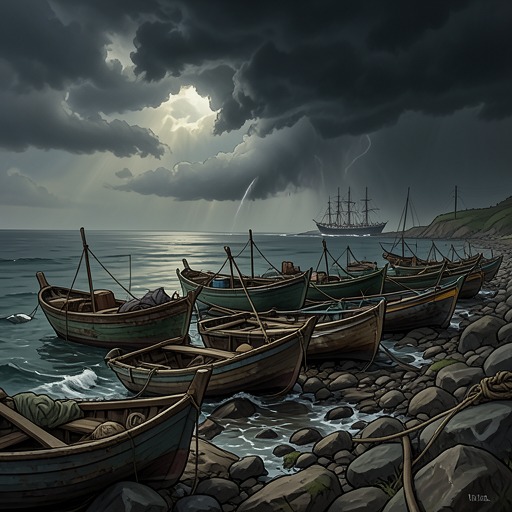
Common SenseThe British Navy is presented in Thomas Paine’s argument as both the visible strength of the British empire and a political-economic burden whose reputation exceeds its deployable force. Its distance from the American coast, commitments across several imperial stations, and dependence on expensive debt, Paine contends, make it less decisive than it appears—and strengthen the case for an American fleet designed around local resources, commerce, and defense.
Imperial Power and Public Cost
Paine links the British Navy to the fiscal scale and political priorities of the British state. Britain, he writes, carries a national debt exceeding £140 million sterling and pays more than £4 million in interest; the navy is the compensation she possesses for that debt. By contrast, America has neither debt nor navy, but Paine argues that a navy twice the size of Britain’s could be obtained for one-twentieth of the English national debt. The comparison turns naval strength into a question of what public borrowing buys, and who bears its cost.
Paine estimates the British fleet’s value at no more than £3.5 million sterling, drawing attention to his calculation of the cost of ships by rate and to a fleet inventory for 1757, when the navy was at what he calls its greatest glory. The figures are offered as evidence rather than as an appeal to the fleet’s impressive reputation: the relevant measure, in his argument, is not the names or apparent scale of the force, but the actual cost and usable strength behind them.
That cost also has a political function. Paine characterizes the English king’s work as making war and distributing offices, thereby impoverishing the nation and setting it against itself. In this account, naval power belongs to a larger system in which imperial war and patronage consume national resources, while the monarchy’s authority diminishes the republican capacity of the House of Commons. The navy’s expense is therefore part of his criticism of the government that commands it, not an isolated accounting objection.
The Gap Between Listed and Available Ships
Paine challenges the impression that Britain could send its entire fleet against America at once. The list of ships of war, he says, is long and formidable, but fewer than one in ten is fit for service at any given time. Some listed ships no longer exist as ships at all: their names remain on the rolls if even a plank is left. Of those that are serviceable, fewer than one in five can be spared for any single station.
The constraint is imperial geography. Britain’s claims extend across the East and West Indies, the Mediterranean, and Africa, among other regions, all of which draw on the same navy. Paine thus counters the assumption that America must immediately match the whole British fleet. The British force is divided among distant obligations; America, with no foreign dominions to defend, could concentrate its naval strength along its own coast.
Distance would continue to shape any encounter. Paine argues that British ships would have to sail three or four thousand miles to attack the continent and travel the same distance again to refit and recruit. Even if Britain checked American trade with Europe through its fleet, he says, America held a corresponding advantage over British trade with the West Indies, which lay near the continent and within its power to threaten. The contest, in this reasoning, is not between two abstract totals of ships, but between a globally dispersed navy and a force operating close to home.
An American Fleet from Local Resources
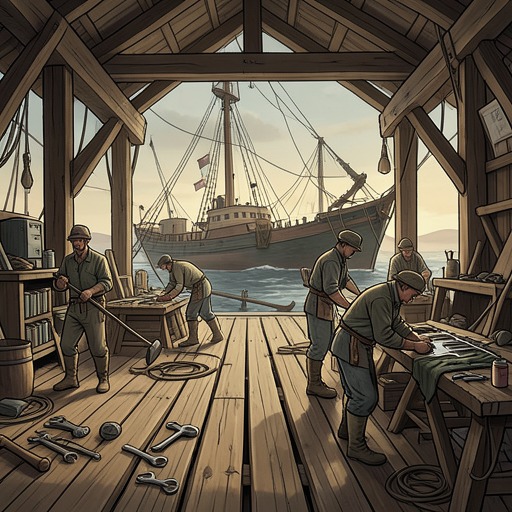
Paine presents naval construction as a practical industry as well as a defensive measure. America, he argues, is exceptionally well situated to raise a fleet because it has tar, timber, iron, and cordage in abundance and would not need to go abroad for the materials. He calls shipbuilding a natural manufacture of the country and proposes treating a fleet as an article of commerce: a completed navy, he maintains, can be worth more than it cost, joining commercial production to protection.
He also rejects the belief that a fleet requires a population composed chiefly of sailors. In his example, the privateer Terrible, commanded by Captain Death, endured the hottest engagement of the previous war with fewer than twenty sailors aboard, despite a complement exceeding two hundred men. A small body of experienced sailors, Paine reasons, could train active landmen in ordinary shipboard work. The argument supports beginning naval preparations while timber remained standing and fishermen, sailors, and shipwrights were out of employment. He adds that ships of seventy and eighty guns had been built in New England forty years earlier, making renewed construction, in his view, an established capacity rather than an untested aspiration.
The proposed fleet would not necessarily require a permanent navy at full strength in peacetime. Paine suggests premiums for merchants who built and used commercial ships mounted with twenty, thirty, forty, or fifty guns, with rewards proportioned to the loss of cargo capacity. Fifty or sixty such vessels, combined with a few guardships on constant duty, could, he proposes, maintain sufficient naval force without leaving a conventional fleet to rot in dock. In this arrangement, merchant investment would serve defense while remaining productive in peace.
Paine’s broader inventory of American resources reinforces the case for self-protection: hemp could supply cordage, iron was abundant, small arms were of high quality, cannon could be cast, and saltpetre and gunpowder were being produced. He presents the ability to build and supply a fleet as part of a wider material capacity, joined to improving knowledge and a tradition of resolution and courage. Naval independence, in this account, is not merely a future military ambition; it follows from resources and productive activity already present.
Security Without Dependence on Britain
Paine grounds the need for a fleet in the vulnerability of American settlements and commerce. The continent, he argues, is no longer the small society it had been sixty years earlier, when people might leave property outdoors and sleep without locks or bolts. A pirate could have sailed up the Delaware and imposed a contribution on Philadelphia, while a daring vessel carrying fourteen or sixteen guns might rob the continent and seize half a million in money. Growth in property, he concludes, has changed the requirements of defense.
Relying on Britain to provide that defense would, for Paine, make security dependent on the very power that had attempted to subdue America. If British ships were stationed in American harbors, their presence could itself become a means of conquest under the appearance of friendship. If they were kept across the Atlantic, a navy three or four thousand miles away could offer little help in an emergency. His question is therefore not simply whether Britain possesses a powerful fleet, but whether a dependent people can safely entrust its protection to that fleet.
The argument also gives naval self-sufficiency a political consequence. Paine warns that if Britain returned to governing America, jealousies and insurrections would persist, and Americans would be asked to risk their lives in forcing their own countrymen back into foreign obedience. He points to a disagreement between Pennsylvania and Connecticut over unlocated lands as evidence that disputes between provinces require continental authority, not distant British rule. A navy based on local resources and directed to local defense belongs to the same larger claim: American security and continental government must be capable of acting for themselves.